
There’s something about taking down all your holiday decorations that puts a magnifying glass against all the things in your home you forgot you have been ignoring. Wreaths get pulled off windows, doors, and mirrors; garland is stripped from staircases, doorways, and mantels. After the sigh of relief that it’s all put away, and you have your house back, it’s common to look around and really *see* your house. The uneven curtain panels in your living room, you swore were only temporary…three years ago. The cluttered bar cabinet you keep meaning to reorganize and style. The half-finished DIY sconces with the shade you never got around to wrapping in that cool fabric that’s still shoved in your closet.
All the things above I mentioned are actually my personal home project shortcomings—and then some. Running my own freelance business and raising an inquisitive toddler who only goes to school half a day leaves me with little time to prioritize things like finally fixing the cafe curtains I made for my dining room over two years ago that bum me out every time I walk by them (that would be many times a day, FYI).
But given that it is that time of year for leaving all your failures in the past and laying out intentions you really hope you can keep past January 15, I’ve decided that I’m resolving myself to stop being blind to the spots in my home I’m less than pleased with and laying out a plan for what and how to tackle them.
First up: Those dining room curtains.
Wait, But How Should I Decide Where to Start?
I want to quickly lay out a few notes that might help you decide on which project should take priority, because if you’re anything like me, the idea of starting and the laundry list of tasks is overwhelming enough to freeze you in your tracks.
Step #1: Start with the most visible (but least daunting) project. The more you see it, the more likely you are to be blind to it (until you have guests and start panicking over it because your everyday house goggles come off and you start seeing things like you think a new person will see it…hint: they don’t). Plus, nothing boosts your confidence and drive more than finally locking in and improving a spot in your home you interact with daily. For me, my dining room curtains are visible almost immediately upon moving through my home, but also from the street. Now for the “least daunting” part of this step. In reality, my living room curtains are more problematic to me than my dining room window coverings. They’re uneven, poorly placed, and look like a sloppy afterthought. But I know that replacing six to eight curtain panels of over 100 inches in addition to a massive curtain rod is going to be massively expensive. My dining room window, though? A far more approachable problem to tackle and check something off my list.
Step #2: Figure out how much money you’re willing to throw at it before starting. Settling on a budget is not a groundbreaking rule for home projects, obviously. But I find it’s often skipped for smaller things with the thought that it just won’t be that expensive…haha try again. Even if it’ll run you a few hundred bucks, as opposed to thousands, it’s important to outline how much you have to spend before running through your options and pricing them out. It might just make your decision that much easier if your choices vary widely in cost.
Step #3: Set a realistic deadline for yourself. “Oh, it won’t take much time at all” you said…two years ago. SET THAT DEADLINE, or else you’ll be adding this same project to your 2027 resolutions list yet again. My advice? Set it around some sort of milestone or landmark so it higher risk if you miss the mark. Meaning, do you have family coming in March to visit for spring break? Do you have a big birthday dinner party on the books for February or April? Give yourself a little buffer of about two weeks prior to allow for troubleshooting or moments of #lifehappens, and work backward from there.
Step #4: DO NOT START ANYTHING NEW BEFORE FINISHING! I capitalize this for dramatic emphasis due to the fact that I wish someone would scream this at me daily upon walking down the stairs to get my morning coffee. Stay focused, finish up, and *then* move on to the next thing. One finished project is worth 10 times what five unfinished projects are. Trust me.
Okay, now that that is sorted, let’s dive into my first project of the year.
An Intro To Arlyn’s Dining Room Curtain Predicament
For reference, here’s what my dining room looked like before we fully moved in. We have these giant windows in nearly every room of our home, and while I first really appreciated them, I quickly learned how tricky they would be to cover in the way I wanted. We inherited mostly broken vertical blinds that all had to come down ASAP for my mental health.
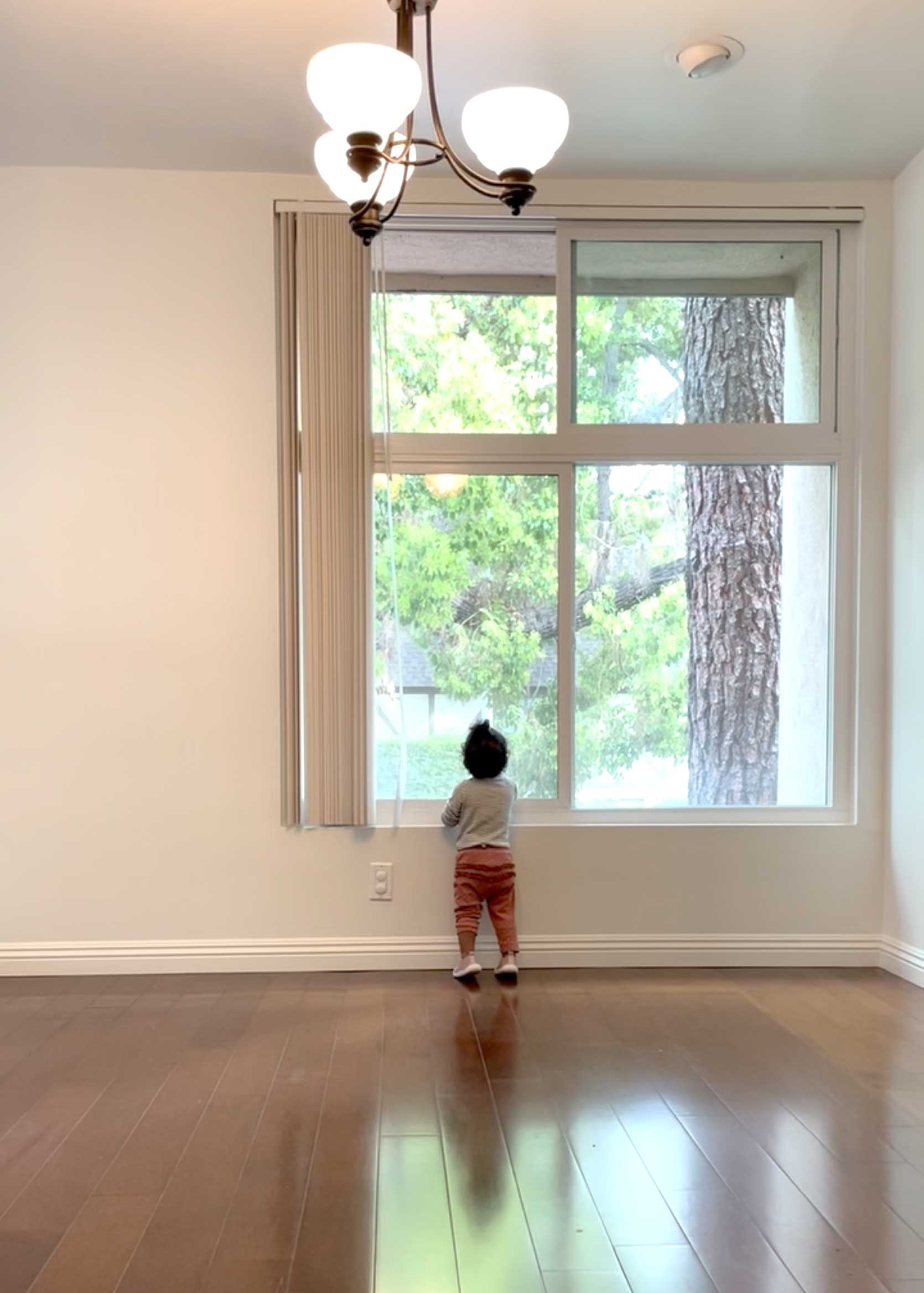 as any parent reading knows, you look back at your kids from a few years prior and your heart absolutely disolves with disbelief at how quickly they grow. i’m crying looking at this tiny nugget.
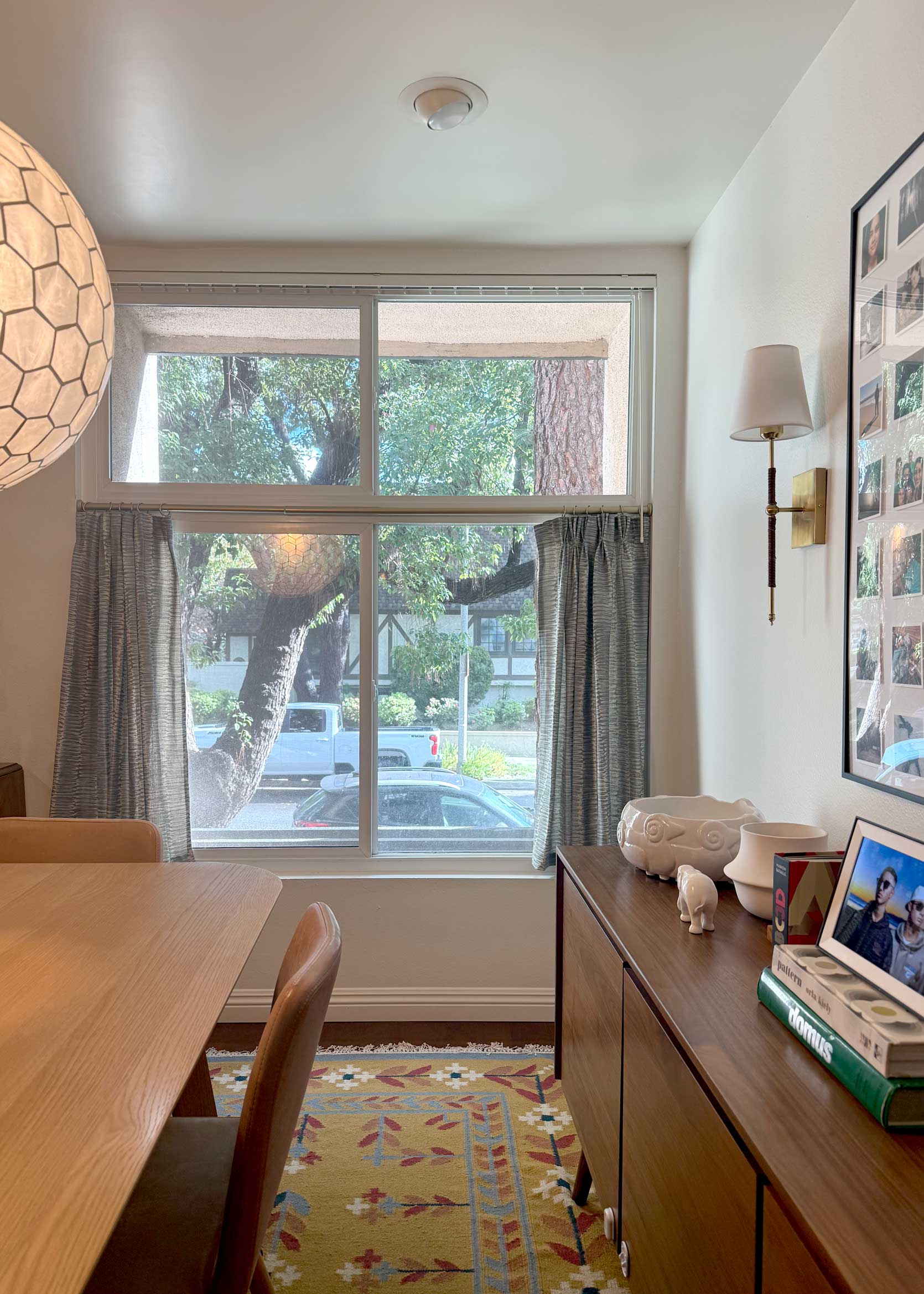
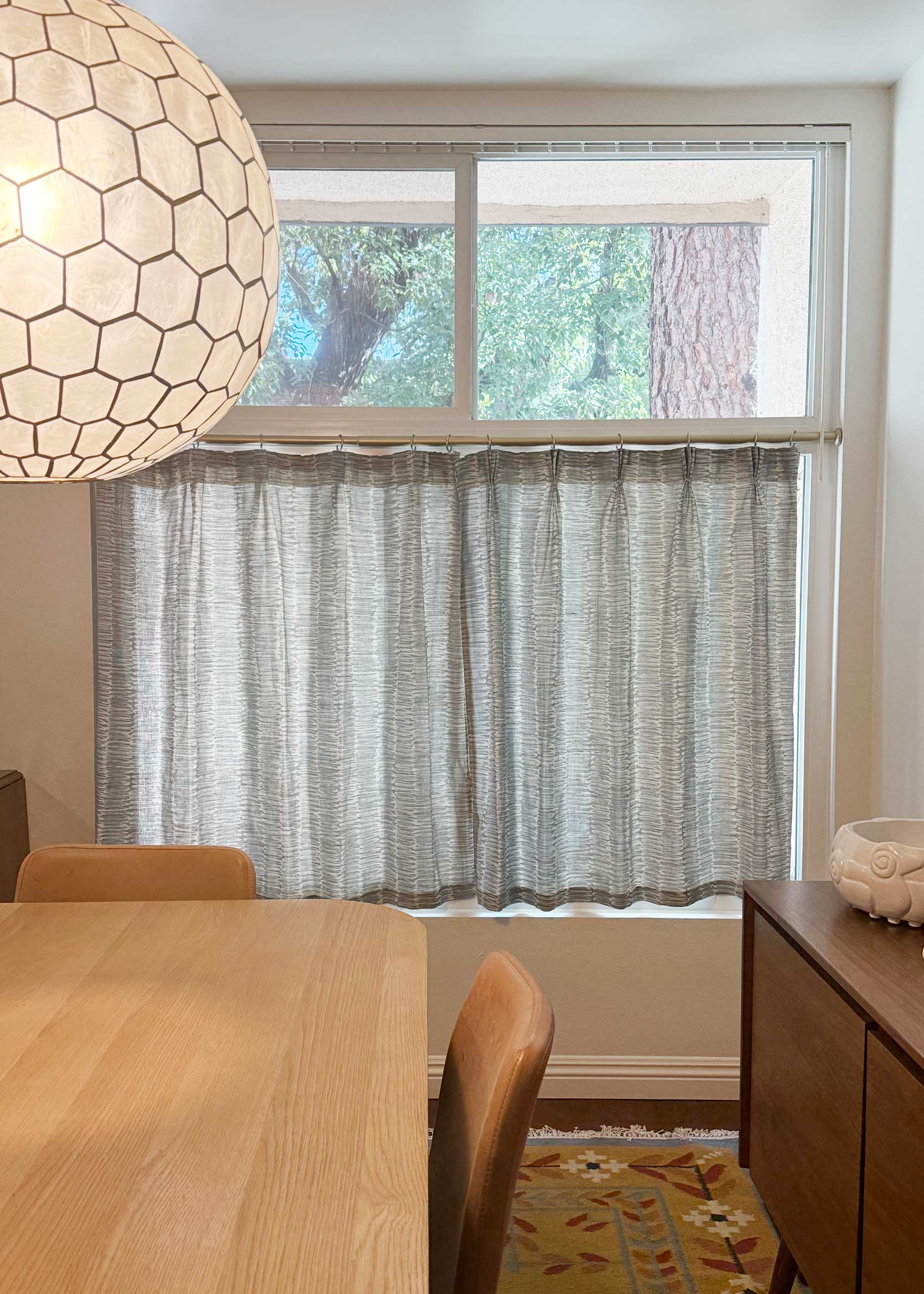
And above is where we are now. As in today, because I just took these photos. Looking at the photos of these cafe curtains, they honestly don’t look *that* bad, but in real life, they don’t work nearly as well as I had imagined they would.
Before settling on this design years ago, I contemplated doing curtain panels, but I really wanted to try something different. Not to mention the ceiling height in my dining room is fairly low, and I thought long drapes would overpower the space that already had a ton of large-scale furniture in it. That, and our home’s perimeter consists of at least a dozen old-growth camphor and pine trees, which means that even though our windows are gargantuan, they do not let in much light. Blocking any of that sunlight, especially from the top part of the window, felt criminal.
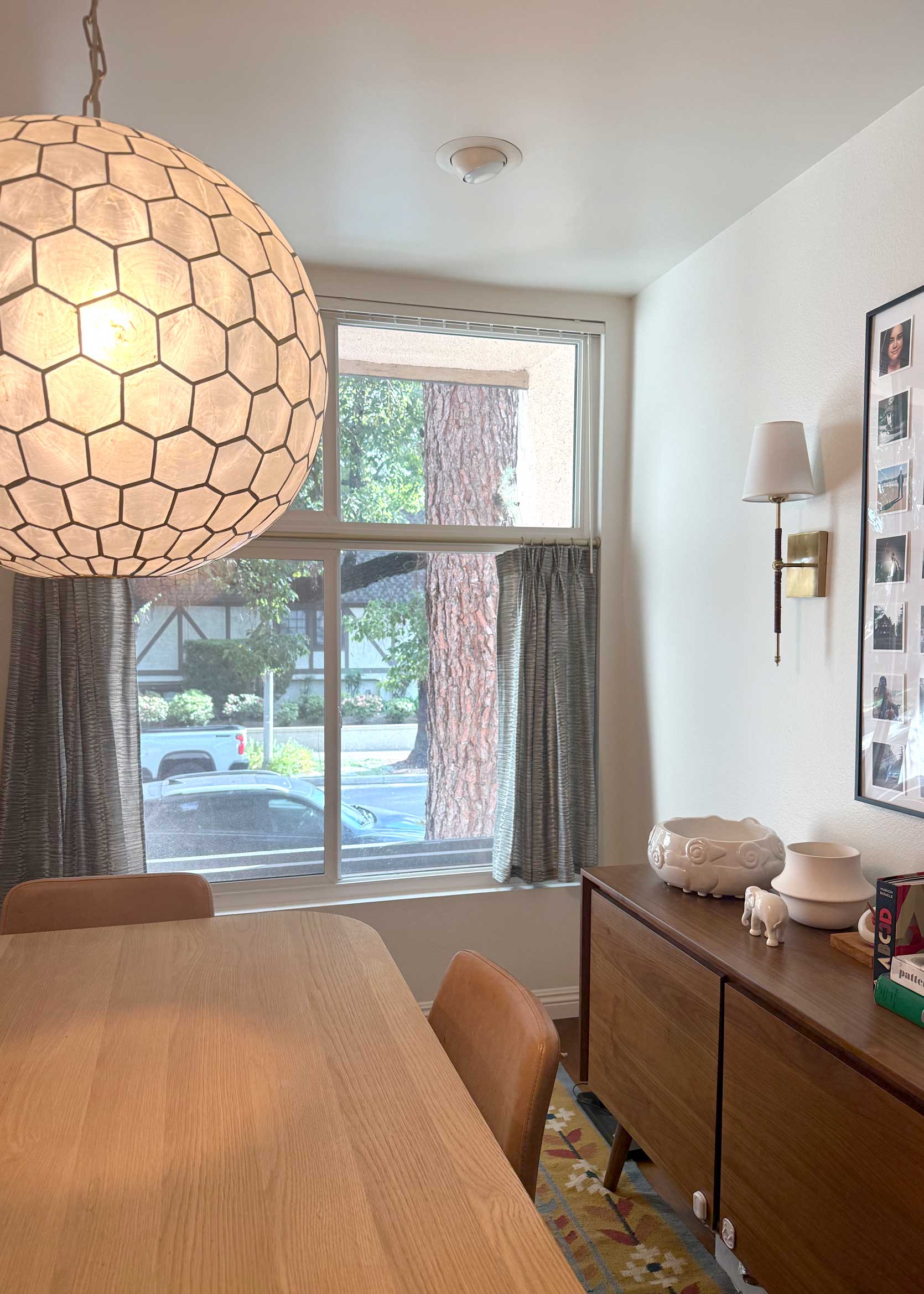 another slightly angled view of the area.
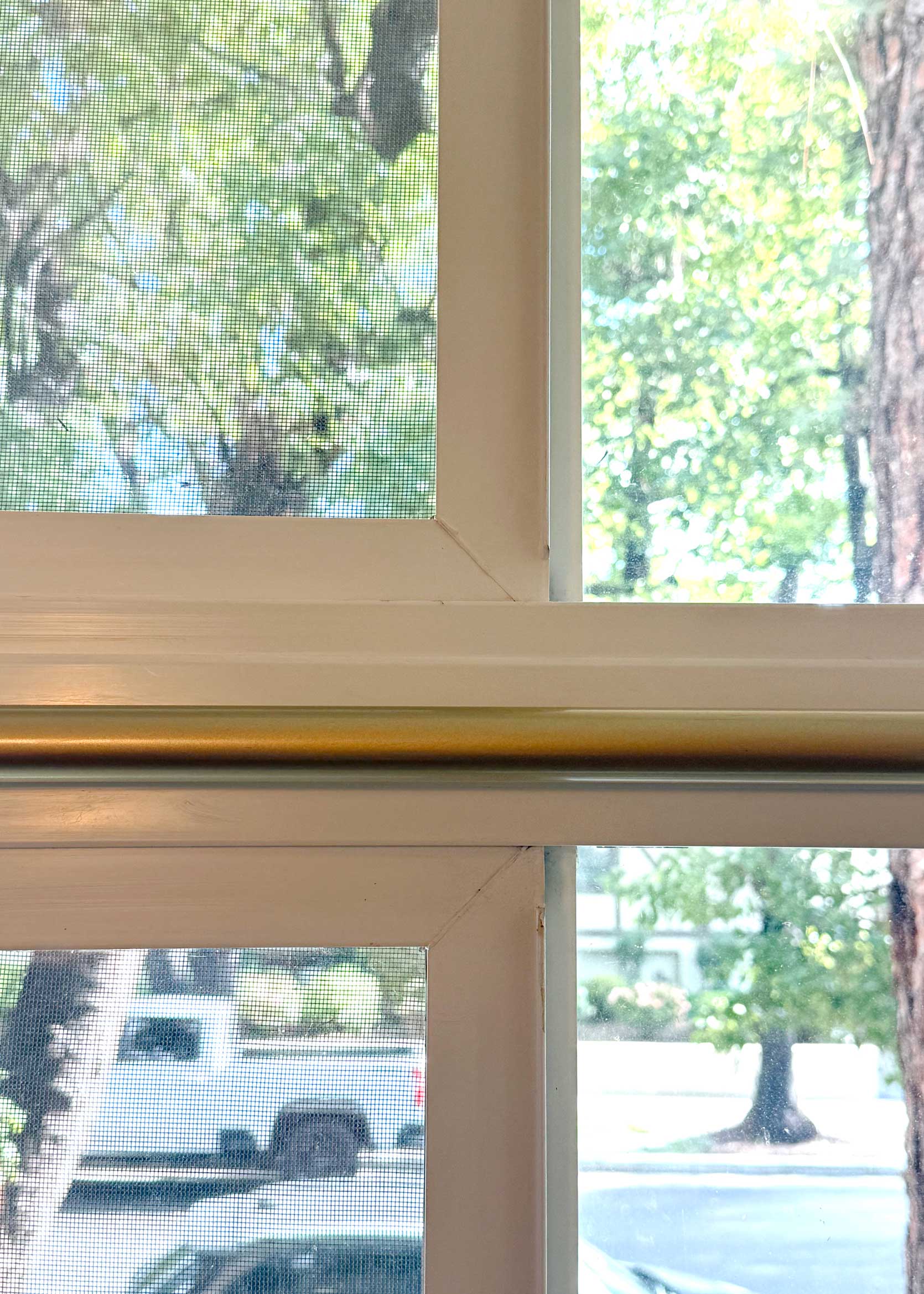 the center line of my window frame is aluminum, so I can’t screw anything into it.
Except that I overlooked that cafe curtains work best on small windows, or at the very least, windows with somewhere to secure a center support. Finding a metal rod strong enough to hold up the weight of curtains and rings across a 75-inch span is near impossible. Because trust me, I tried. There’s a graveyard of bad choices in my garage from this very project. The only thing that ended up working (and I use that term loosely) was a 1-inch diameter tension rod. The result was always something I didn’t love, partly due to the fact that it has a plastic ring at eye level where the rod extends, but also because the inset of the window is barely any deeper, so the curtains puff out weirdly without room to move.
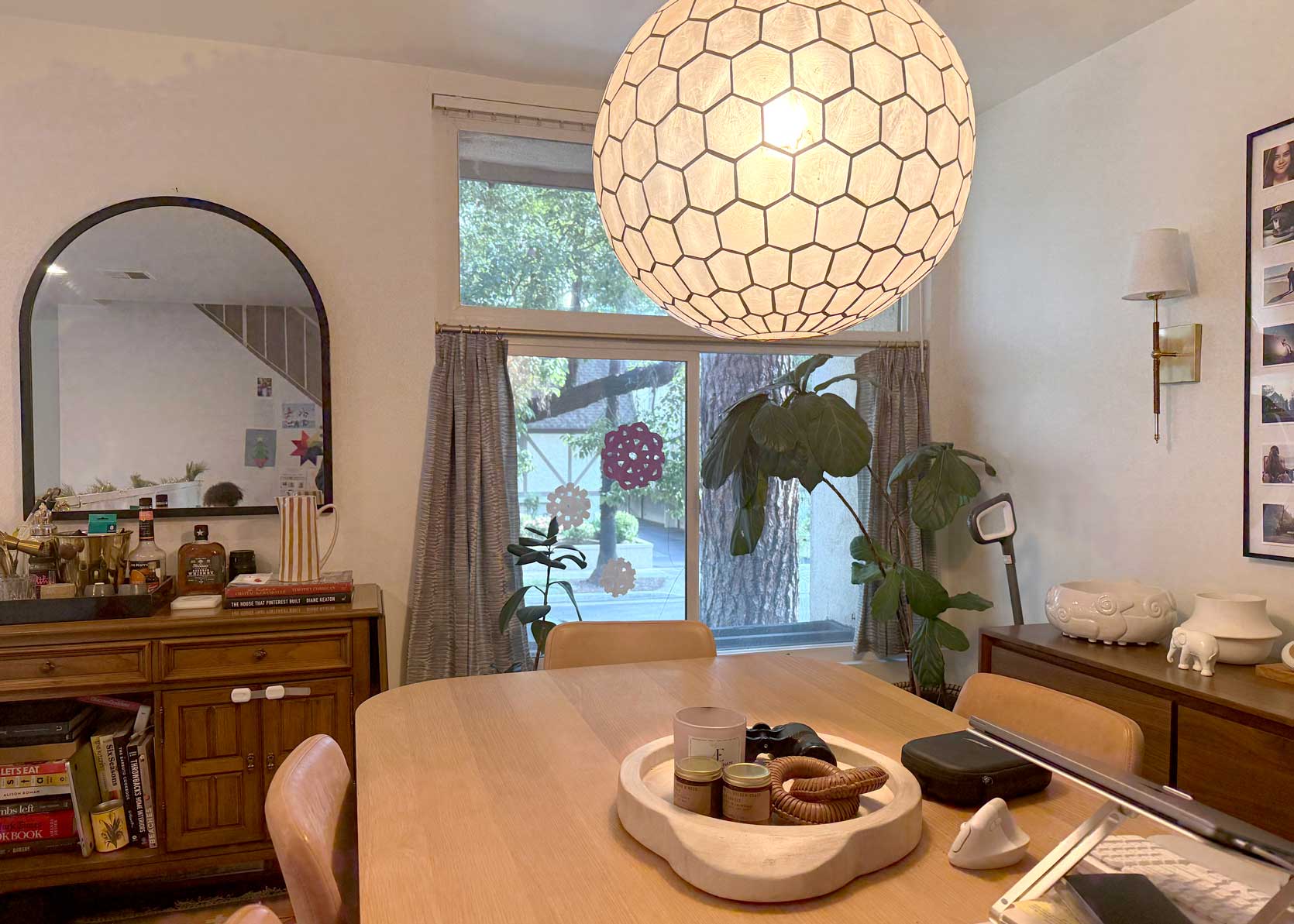
You can see the flaring of the curtains here better, which frankly is mostly due to the fact that I fell in love with this Rebecca Atwood fabric but failed to ask them if it worked well for drapery. This is much better suited for upholstery and pillows as it doesn’t hang very well—something I only came to realize after spending the time to sew the panels. I can still remember the night I put them up, and immediately felt my excitement tank, only to be replaced with regret and disappointment.
Unrelated, this is a good photo to see the space a bit better and how it typically looks. The bar is cluttered, my workspace takes up one side of the dining table, the corner is the only place we can plug in our Tineco wet mop, and there are a few plants by that window holding on for dear life. It feels busy, overly tight, but also somehow kind of boring.
How I Can Make It Work
There’s a world where I lean in and just make this work. We won’t be living here forever (or possibly even much longer than this year), so why spend the mental/creative energy and money on doing too much to change it if it’s a short-term solution? I’ve lived with it this long; I can surely keep living with it with a few tweaks. I outlined a few make-it-work options below.
Make-It-Work Option #1: Add an interesting border to the sides and bottom of existing curtains.
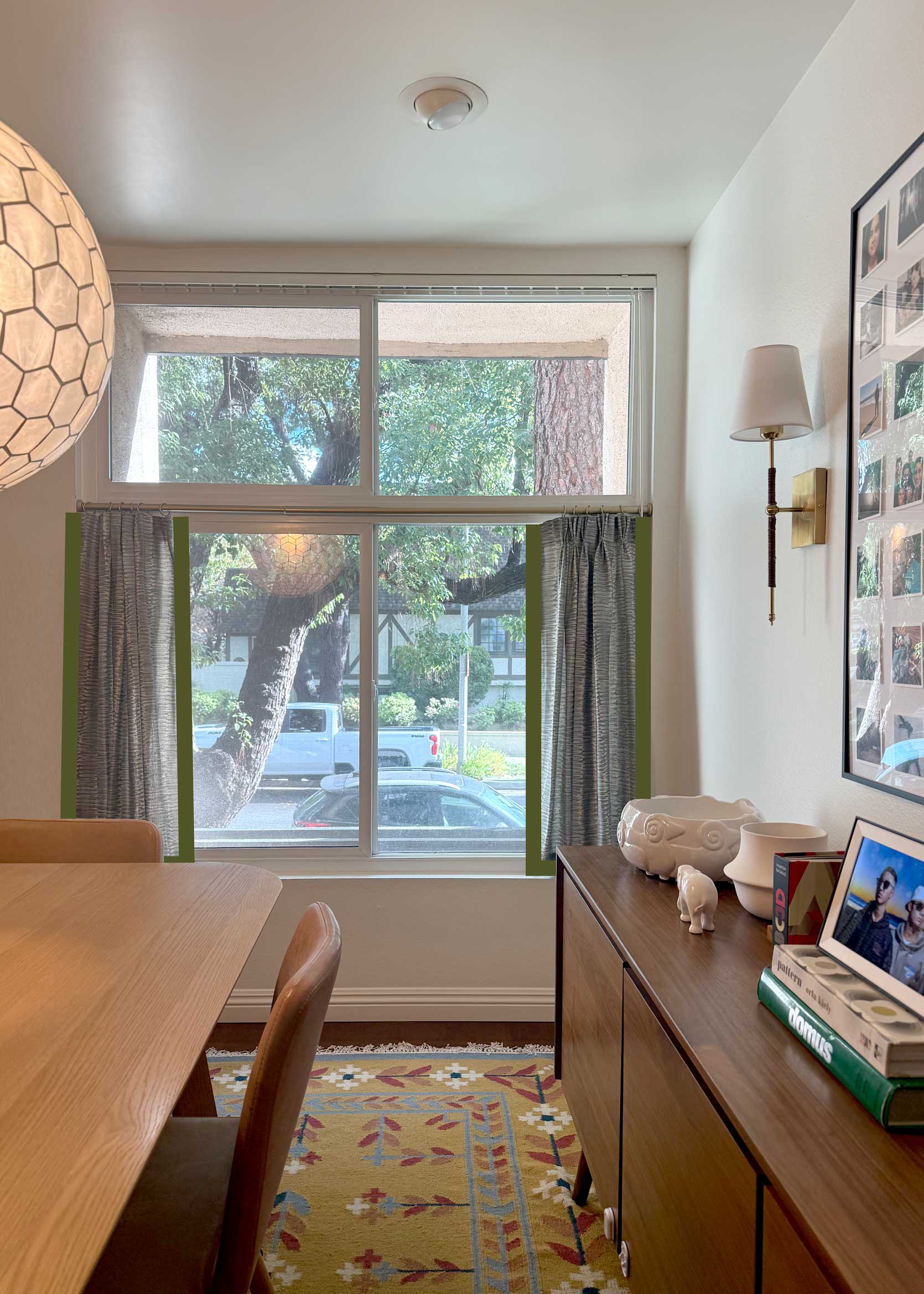
Something that isn’t super obvious in my photos is that the curtains are too small. I sewed them and slightly undershot their length and very much underestimated their width after pleating. In order to close them, you have to place them *just so* so you can’t see in from the street. And I let go of some of the bottom hem to lengthen them, but they are still hovering over an inch above the windowsill.
A way to fix that, I thought, was to simply add to the finished curtain, either pleated or unpleated. I actually let the pleat out on the left panel to see how that would look. Spoiler: I didn’t love it, but I left it that way so that we could actually close the curtains at night. And then I forgot I did that and never went back to deal with the other panel, so now I have one pleated and one non-pleated curtain. Cool.
However, I could go back, pleat the left panel, then add two-inch ribbon all along the sides and bottom. I think this would be better in theory than in practice, given the thickness of the fabric and how flimsy a ribbon may look when affixed to it. This, however, would not improve the look of the tension rod.
Make-It-Work Option #2: Remake curtains with a different fabric and dimensions.
I decided to mock up what some lighter linen or cotton would look like. Maybe the issue isn’t the idea of the cafe curtains but rather the curtain I made itself. A wispy semi-sheer fabric would drape much better, still let in some light, and not be as heavy if I figure out a different rod.
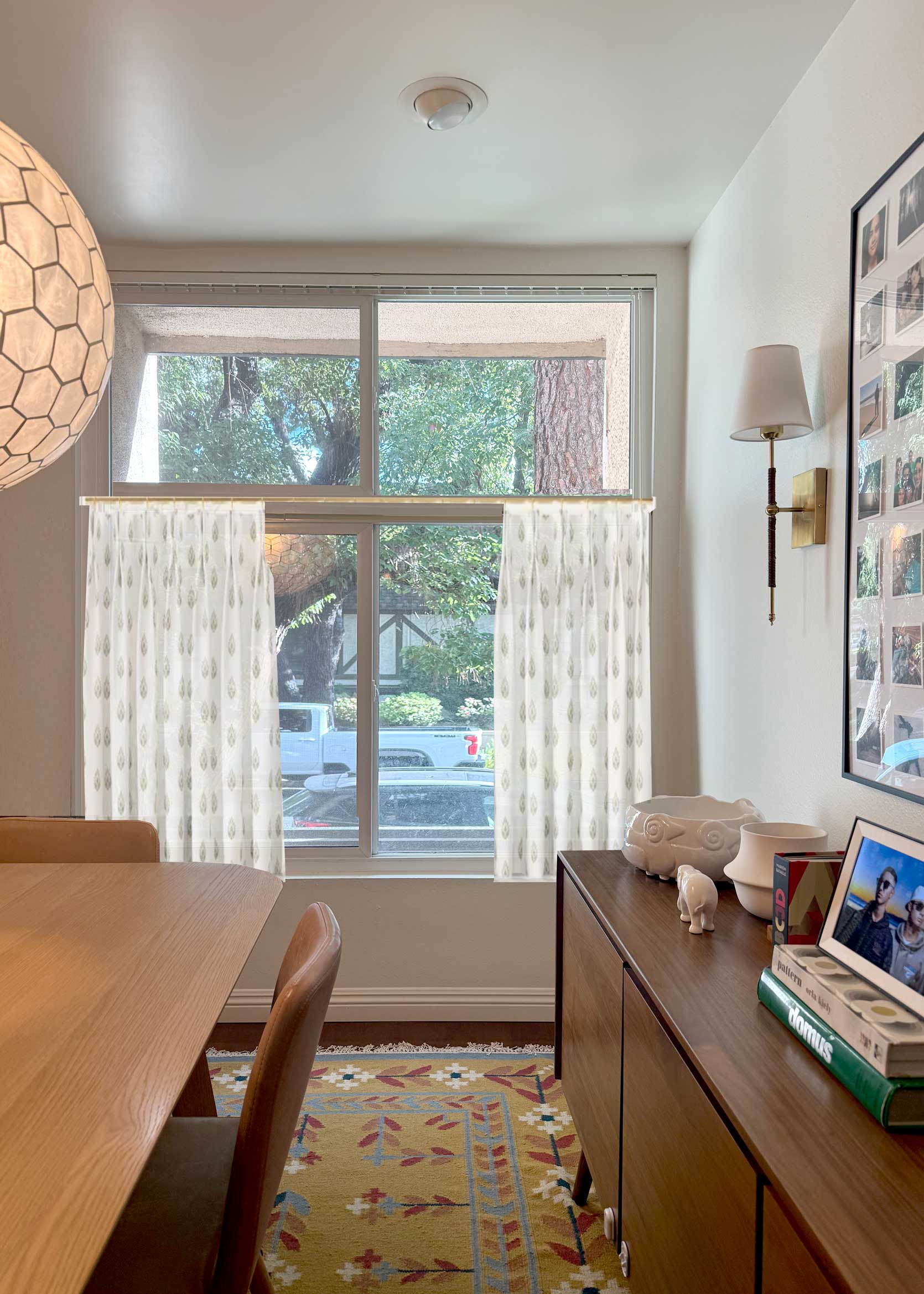 Cafe Curtains by Twopages
I know the colors here would look better IRL, but I’m not that into this. (Also, it is just now that I’m realizing the vertical blinds track is STILL on the top of this window…) Possibly a different fabric would be better, but meh.
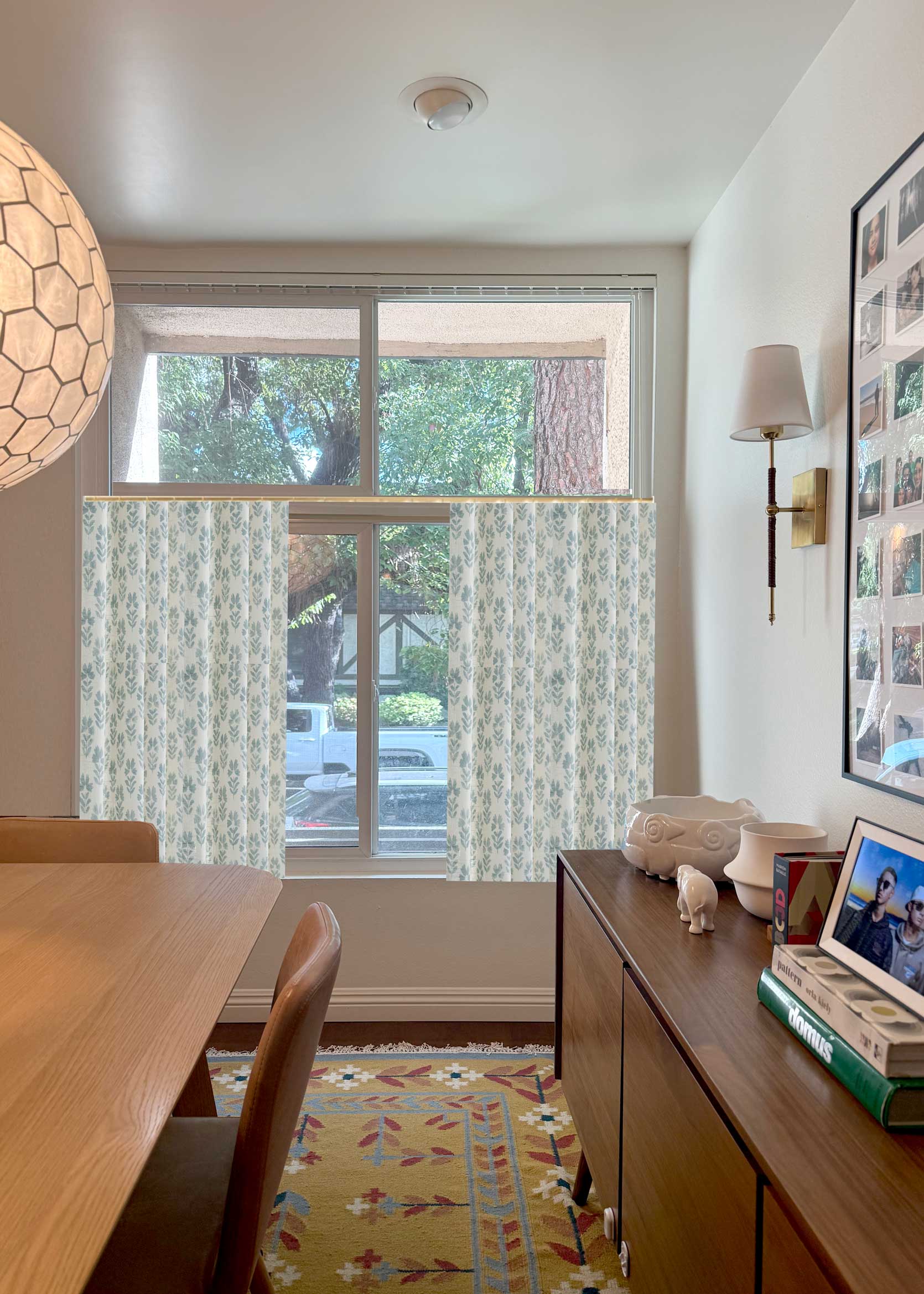
Cafe Curtain Fabric by Tonic
I do like this more than the first option, but I’m starting to think not all windows can make cafe curtains work.
Other Options If I Move On
Maybe I should cut my losses and try something else. Though I originally didn’t want curtain panels here, I’m softening to the idea. As long as I simplify the styling on all my surfaces and pare back the plants, it may not be as visually overwhelming as I thought it would be. Let’s see how this option fares in Photoshop.
Move On Option #1: Install curtain panels.
As I mentioned, I was hesitant from the get-go to do curtains here, but I acknowledge that they are the most versatile choice for the future. Whenever we decide to move, we could take these with us and reuse them (as long as the height works). I went ahead and mocked up a neutral option and a colorful one.
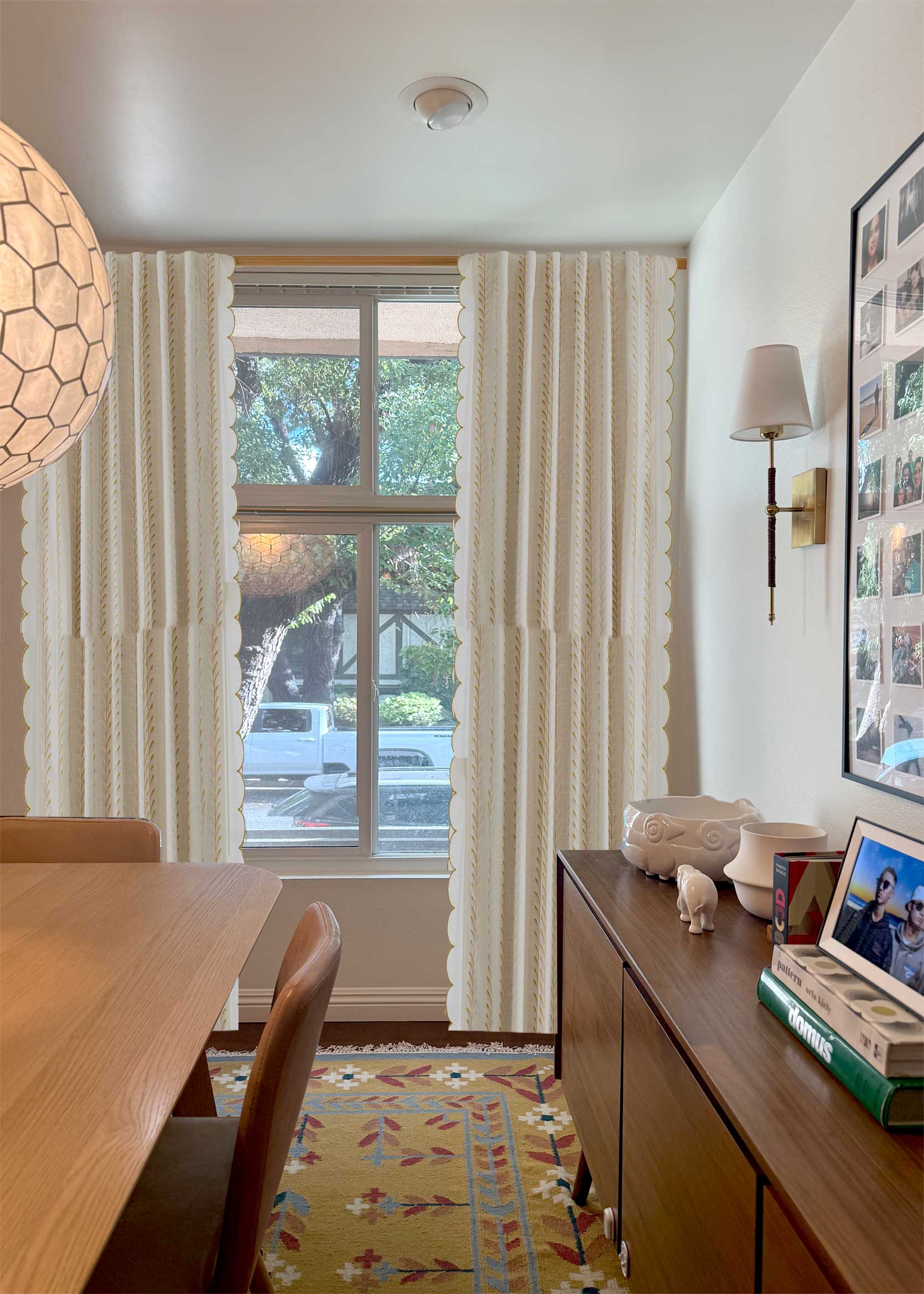
Curtain Panels from West Elm
Okay! Wait…I like this. Pay no mind to the quick Photoshop job of extending the panels. West Elm’s product page only shows a tiny bit of the top, so this is the best I could do without bringing in AI (no thanks). This feels lovely and light, but still interesting thanks to the subtle pattern and scalloped edges.

Curtain Panels from West Elm
I am surprised by how much I love this. I do worry that it’ll come off heavier in person, but the mauve-y hue helps to bridge the gap between the wood tones in the room and the rug (the Danish Floral Flat-Weave Wool Rug from Garnet Hill, which adds some nice pattern to this otherwise simple space).
Move On Option #2: Install Roman shades.
Now, I wanted to explore some Roman shades here, as I think that will be a cleaner, more tailored look for the small space. Truthfully, though, the investment is too much for this window size to justify how long we’ll be here. Maybe if I had done this three years ago, but I can’t spend this much for something that would be custom-sized for this specific window and can’t come with us.
But by looks alone, I can see that it’s a top contender.
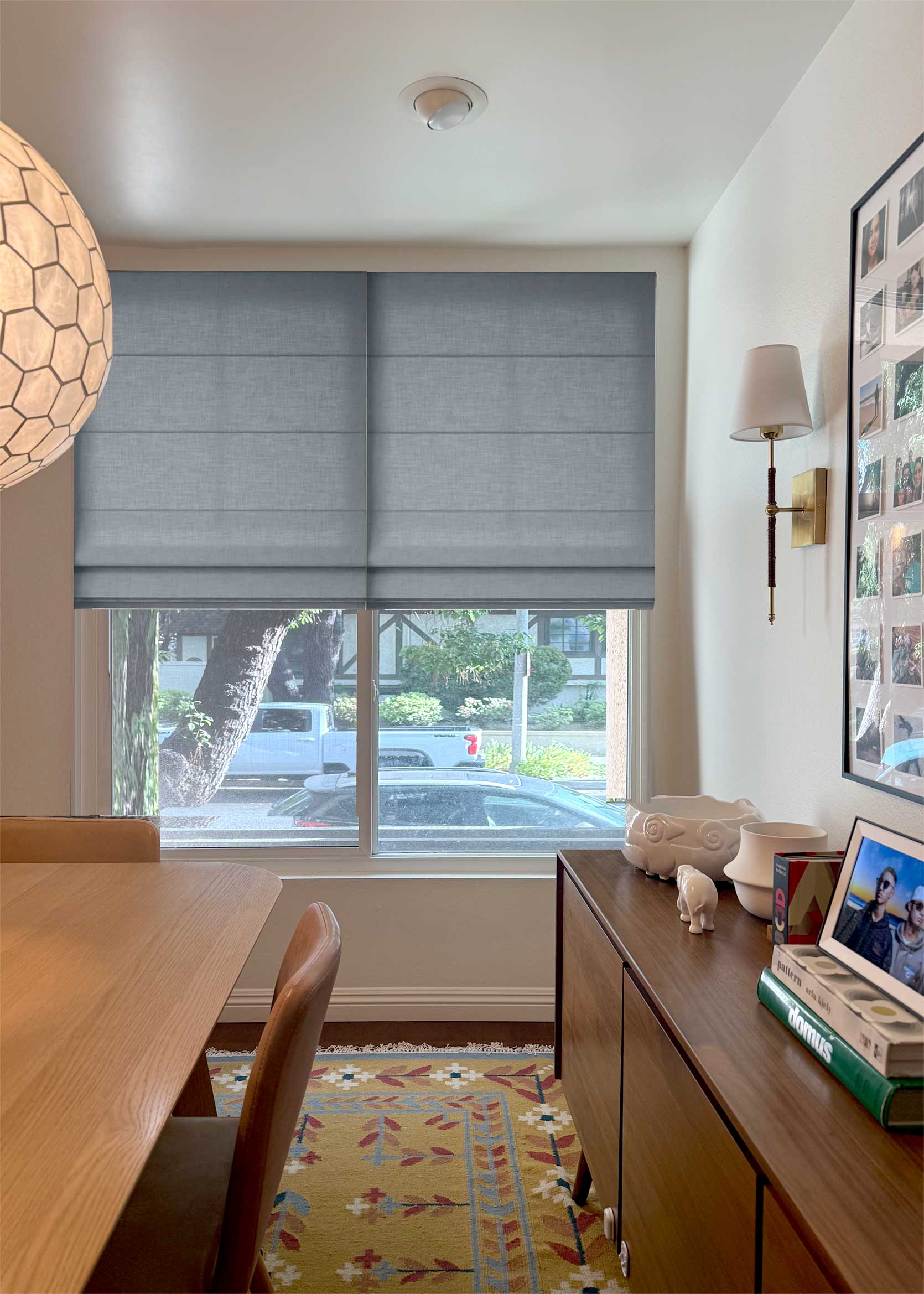
Roman Shade by Select Blinds
The streamlined look of a Roman shade is exactly what this room needs, TBH. A shade leaves the valuable floor space open, I can better control the light during the day, and they don’t overwhelm the low ceilings. A blue pulls in the palette from the rug and adds some interest to the landlord white walls.
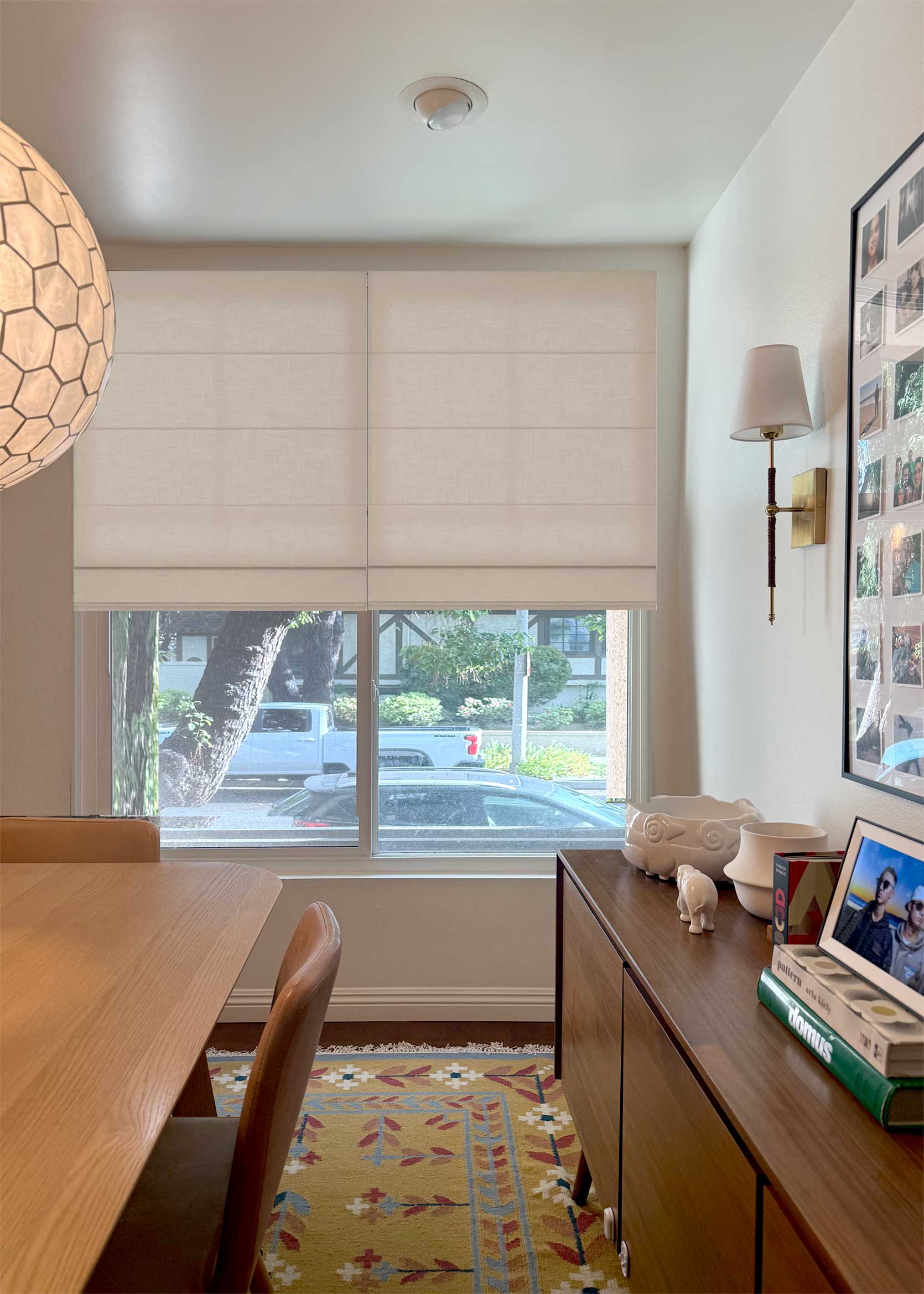
Roman Shade by Select Blinds
To scratch the neutral itch I sometimes have due to internet overload, here’s a mock-up of a neutral beige Roman shade. I like it enough as a rest for the eyes, but it doesn’t do much for me. This would be better for me if there were a subtle pinstripe or pattern.
So…What’s The Solution?
Good question! Scrolling back through the images I Photoshopped, I keep going back to those earthy mauve curtains. I would have never guessed that’s what I’d like the most had I not mocked them up. I was convinced a Roman shade would look best, and while it suits the space well, the colored curtain better suits my personal tastes. Given that two of those panels will run me nearly $350, I had a bonus idea: Take two white curtain panels I already have in storage, try to dye them a similar color, and hang those on a pretty brass curtain rod that was meant for my bedroom, I never hung because I didn’t end up having the wall clearance for it. That way, my only expense is the dye and the time it takes me to work through the project.
If it ends up being ugly, then I’ve lost almost nothing and am no worse off. But if it’s pretty good, I can always upgrade to the real deal if it feels like we’ll be here longer than anticipated.
I’m pretty excited, tbh. My deadline? The end of the month. I’ll be sure to share an update when I make some moves. Stay tuned until next time, friends.
There’s something about taking down all your holiday decorations that puts a magnifying glass against all the things in your home you forgot you have been ignoring. Wreaths get pulled off windows, doors, and mirrors; garland is stripped from staircases, doorways, and mantels. After the sigh of relief that it’s all put away, and you have your house back, it’s common to look around and really *see* your house. The uneven curtain panels in your living room, you swore were only temporary…three years ago. The cluttered bar cabinet you keep meaning to reorganize and style. The half-finished DIY sconces with the shade you never got around to wrapping in that cool fabric that’s still shoved in your closet.
All the things above I mentioned are actually my personal home project shortcomings—and then some. Running my own freelance business and raising an inquisitive toddler who only goes to school half a day leaves me with little time to prioritize things like finally fixing the cafe curtains I made for my dining room over two years ago that bum me out every time I walk by them (that would be many times a day, FYI).
But given that it is that time of year for leaving all your failures in the past and laying out intentions you really hope you can keep past January 15, I’ve decided that I’m resolving myself to stop being blind to the spots in my home I’m less than pleased with and laying out a plan for what and how to tackle them.
First up: Those dining room curtains.
Wait, But How Should I Decide Where to Start?
I want to quickly lay out a few notes that might help you decide on which project should take priority, because if you’re anything like me, the idea of starting and the laundry list of tasks is overwhelming enough to freeze you in your tracks.
Step #1: Start with the most visible (but least daunting) project. The more you see it, the more likely you are to be blind to it (until you have guests and start panicking over it because your everyday house goggles come off and you start seeing things like you think a new person will see it…hint: they don’t). Plus, nothing boosts your confidence and drive more than finally locking in and improving a spot in your home you interact with daily. For me, my dining room curtains are visible almost immediately upon moving through my home, but also from the street. Now for the “least daunting” part of this step. In reality, my living room curtains are more problematic to me than my dining room window coverings. They’re uneven, poorly placed, and look like a sloppy afterthought. But I know that replacing six to eight curtain panels of over 100 inches in addition to a massive curtain rod is going to be massively expensive. My dining room window, though? A far more approachable problem to tackle and check something off my list.
Step #2: Figure out how much money you’re willing to throw at it before starting. Settling on a budget is not a groundbreaking rule for home projects, obviously. But I find it’s often skipped for smaller things with the thought that it just won’t be that expensive…haha try again. Even if it’ll run you a few hundred bucks, as opposed to thousands, it’s important to outline how much you have to spend before running through your options and pricing them out. It might just make your decision that much easier if your choices vary widely in cost.
Step #3: Set a realistic deadline for yourself. “Oh, it won’t take much time at all” you said…two years ago. SET THAT DEADLINE, or else you’ll be adding this same project to your 2027 resolutions list yet again. My advice? Set it around some sort of milestone or landmark so it higher risk if you miss the mark. Meaning, do you have family coming in March to visit for spring break? Do you have a big birthday dinner party on the books for February or April? Give yourself a little buffer of about two weeks prior to allow for troubleshooting or moments of #lifehappens, and work backward from there.
Step #4: DO NOT START ANYTHING NEW BEFORE FINISHING! I capitalize this for dramatic emphasis due to the fact that I wish someone would scream this at me daily upon walking down the stairs to get my morning coffee. Stay focused, finish up, and *then* move on to the next thing. One finished project is worth 10 times what five unfinished projects are. Trust me.
Okay, now that that is sorted, let’s dive into my first project of the year.
An Intro To Arlyn’s Dining Room Curtain Predicament
For reference, here’s what my dining room looked like before we fully moved in. We have these giant windows in nearly every room of our home, and while I first really appreciated them, I quickly learned how tricky they would be to cover in the way I wanted. We inherited mostly broken vertical blinds that all had to come down ASAP for my mental health.
as any parent reading knows, you look back at your kids from a few years prior and your heart absolutely disolves with disbelief at how quickly they grow. i’m crying looking at this tiny nugget.
And above is where we are now. As in today, because I just took these photos. Looking at the photos of these cafe curtains, they honestly don’t look *that* bad, but in real life, they don’t work nearly as well as I had imagined they would.
Before settling on this design years ago, I contemplated doing curtain panels, but I really wanted to try something different. Not to mention the ceiling height in my dining room is fairly low, and I thought long drapes would overpower the space that already had a ton of large-scale furniture in it. That, and our home’s perimeter consists of at least a dozen old-growth camphor and pine trees, which means that even though our windows are gargantuan, they do not let in much light. Blocking any of that sunlight, especially from the top part of the window, felt criminal.
another slightly angled view of the area.
the center line of my window frame is aluminum, so I can’t screw anything into it.
Except that I overlooked that cafe curtains work best on small windows, or at the very least, windows with somewhere to secure a center support. Finding a metal rod strong enough to hold up the weight of curtains and rings across a 75-inch span is near impossible. Because trust me, I tried. There’s a graveyard of bad choices in my garage from this very project. The only thing that ended up working (and I use that term loosely) was a 1-inch diameter tension rod. The result was always something I didn’t love, partly due to the fact that it has a plastic ring at eye level where the rod extends, but also because the inset of the window is barely any deeper, so the curtains puff out weirdly without room to move.
You can see the flaring of the curtains here better, which frankly is mostly due to the fact that I fell in love with this Rebecca Atwood fabric but failed to ask them if it worked well for drapery. This is much better suited for upholstery and pillows as it doesn’t hang very well—something I only came to realize after spending the time to sew the panels. I can still remember the night I put them up, and immediately felt my excitement tank, only to be replaced with regret and disappointment.
Unrelated, this is a good photo to see the space a bit better and how it typically looks. The bar is cluttered, my workspace takes up one side of the dining table, the corner is the only place we can plug in our Tineco wet mop, and there are a few plants by that window holding on for dear life. It feels busy, overly tight, but also somehow kind of boring.
How I Can Make It Work
There’s a world where I lean in and just make this work. We won’t be living here forever (or possibly even much longer than this year), so why spend the mental/creative energy and money on doing too much to change it if it’s a short-term solution? I’ve lived with it this long; I can surely keep living with it with a few tweaks. I outlined a few make-it-work options below.
Make-It-Work Option #1: Add an interesting border to the sides and bottom of existing curtains.
Something that isn’t super obvious in my photos is that the curtains are too small. I sewed them and slightly undershot their length and very much underestimated their width after pleating. In order to close them, you have to place them *just so* so you can’t see in from the street. And I let go of some of the bottom hem to lengthen them, but they are still hovering over an inch above the windowsill.
A way to fix that, I thought, was to simply add to the finished curtain, either pleated or unpleated. I actually let the pleat out on the left panel to see how that would look. Spoiler: I didn’t love it, but I left it that way so that we could actually close the curtains at night. And then I forgot I did that and never went back to deal with the other panel, so now I have one pleated and one non-pleated curtain. Cool.
However, I could go back, pleat the left panel, then add two-inch ribbon all along the sides and bottom. I think this would be better in theory than in practice, given the thickness of the fabric and how flimsy a ribbon may look when affixed to it. This, however, would not improve the look of the tension rod.
Make-It-Work Option #2: Remake curtains with a different fabric and dimensions.
I decided to mock up what some lighter linen or cotton would look like. Maybe the issue isn’t the idea of the cafe curtains but rather the curtain I made itself. A wispy semi-sheer fabric would drape much better, still let in some light, and not be as heavy if I figure out a different rod.
Cafe Curtains by Twopages
I know the colors here would look better IRL, but I’m not that into this. (Also, it is just now that I’m realizing the vertical blinds track is STILL on the top of this window…) Possibly a different fabric would be better, but meh.
Cafe Curtain Fabric by Tonic
I do like this more than the first option, but I’m starting to think not all windows can make cafe curtains work.
Other Options If I Move On
Maybe I should cut my losses and try something else. Though I originally didn’t want curtain panels here, I’m softening to the idea. As long as I simplify the styling on all my surfaces and pare back the plants, it may not be as visually overwhelming as I thought it would be. Let’s see how this option fares in Photoshop.
Move On Option #1: Install curtain panels.
As I mentioned, I was hesitant from the get-go to do curtains here, but I acknowledge that they are the most versatile choice for the future. Whenever we decide to move, we could take these with us and reuse them (as long as the height works). I went ahead and mocked up a neutral option and a colorful one.
Curtain Panels from West Elm
Okay! Wait…I like this. Pay no mind to the quick Photoshop job of extending the panels. West Elm’s product page only shows a tiny bit of the top, so this is the best I could do without bringing in AI (no thanks). This feels lovely and light, but still interesting thanks to the subtle pattern and scalloped edges.
Curtain Panels from West Elm
I am surprised by how much I love this. I do worry that it’ll come off heavier in person, but the mauve-y hue helps to bridge the gap between the wood tones in the room and the rug (the Danish Floral Flat-Weave Wool Rug from Garnet Hill, which adds some nice pattern to this otherwise simple space).
Move On Option #2: Install Roman shades.
Now, I wanted to explore some Roman shades here, as I think that will be a cleaner, more tailored look for the small space. Truthfully, though, the investment is too much for this window size to justify how long we’ll be here. Maybe if I had done this three years ago, but I can’t spend this much for something that would be custom-sized for this specific window and can’t come with us.
But by looks alone, I can see that it’s a top contender.
Roman Shade by Select Blinds
The streamlined look of a Roman shade is exactly what this room needs, TBH. A shade leaves the valuable floor space open, I can better control the light during the day, and they don’t overwhelm the low ceilings. A blue pulls in the palette from the rug and adds some interest to the landlord white walls.
Roman Shade by Select Blinds
To scratch the neutral itch I sometimes have due to internet overload, here’s a mock-up of a neutral beige Roman shade. I like it enough as a rest for the eyes, but it doesn’t do much for me. This would be better for me if there were a subtle pinstripe or pattern.
So…What’s The Solution?
Good question! Scrolling back through the images I Photoshopped, I keep going back to those earthy mauve curtains. I would have never guessed that’s what I’d like the most had I not mocked them up. I was convinced a Roman shade would look best, and while it suits the space well, the colored curtain better suits my personal tastes. Given that two of those panels will run me nearly $350, I had a bonus idea: Take two white curtain panels I already have in storage, try to dye them a similar color, and hang those on a pretty brass curtain rod that was meant for my bedroom, I never hung because I didn’t end up having the wall clearance for it. That way, my only expense is the dye and the time it takes me to work through the project.
If it ends up being ugly, then I’ve lost almost nothing and am no worse off. But if it’s pretty good, I can always upgrade to the real deal if it feels like we’ll be here longer than anticipated.
I’m pretty excited, tbh. My deadline? The end of the month. I’ll be sure to share an update when I make some moves. Stay tuned until next time, friends.